Healthcare is becoming more digital, more connected, and more data-driven than ever before. Yet many hospitals still rely on legacy software or server-based systems that create operational bottlenecks, increase IT dependency, and limit scalability.
As patient expectations rise and compliance requirements become stricter, hospitals need technology that is flexible, secure, and built for growth.
This is why more hospitals are moving to a Cloud-Based Hospital Management System (HMS).
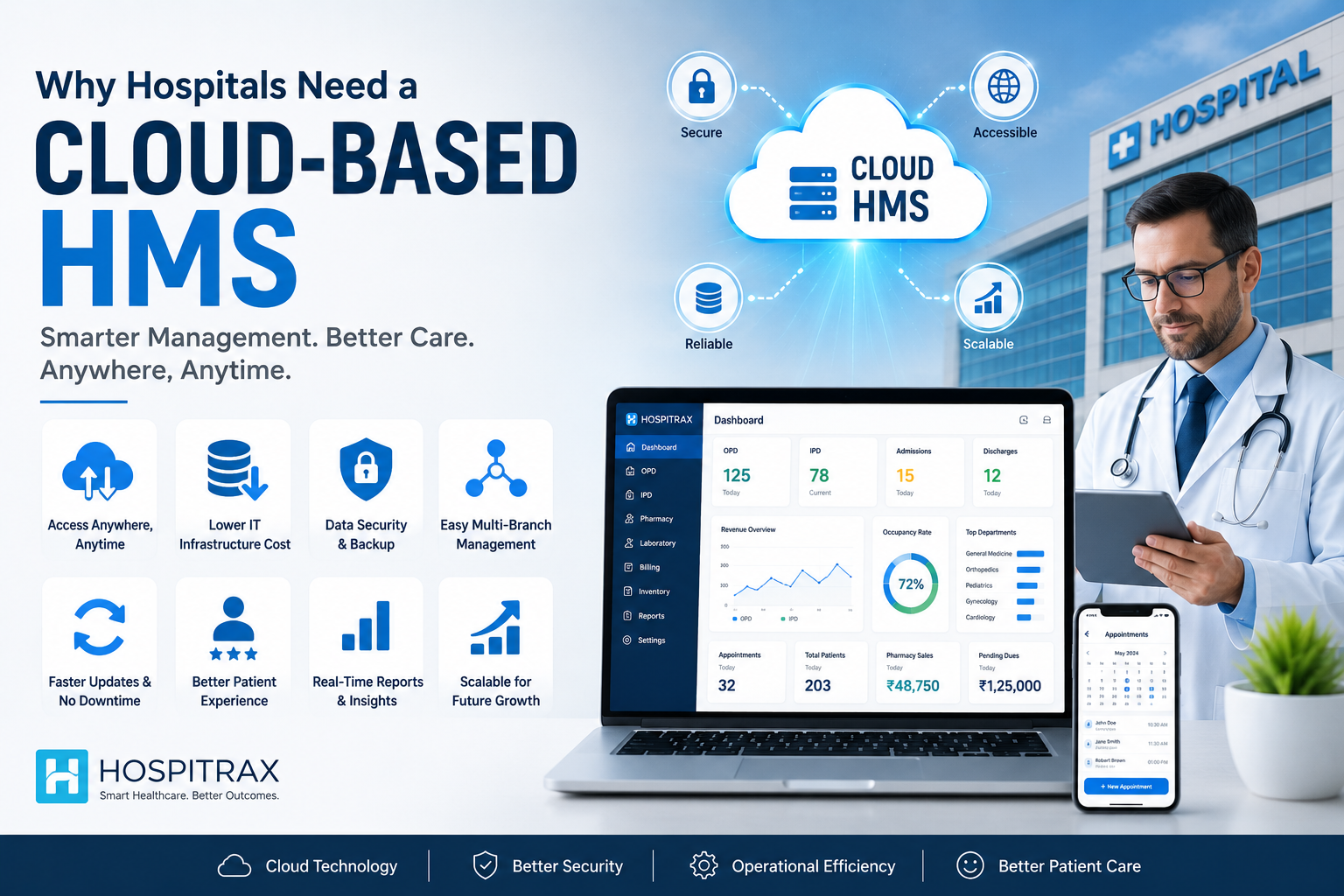
A cloud-based HMS helps hospitals streamline operations, access data in real time, reduce infrastructure costs, and improve both staff productivity and patient experience—all from a centralized platform.
What is a Cloud-Based Hospital Management System?
A Cloud-Based Hospital Management System (HMS) is hospital software hosted on secure cloud servers instead of on-premise hardware inside the hospital.
It allows hospitals to manage daily operations digitally through an internet-connected platform.
A cloud HMS typically manages:
- Patient Registration
- OPD Management
- IPD Management
- Billing & Insurance
- Pharmacy
- Laboratory
- Radiology
- Appointment Scheduling
- EMR / EHR
- Bed Management
- OT Management
- MIS Reports
- Inventory & Procurement
- Doctor & Staff Management
All data is stored securely in the cloud and can be accessed anytime from authorized devices.
Why Hospitals Are Shifting from Server-Based to Cloud HMS
Traditional hospital software often creates limitations over time:
- High server maintenance costs
- Limited remote access
- Frequent downtime during hardware failures
- Difficult upgrades
- Data backup risks
- Heavy dependency on local IT teams
- Complex multi-location management
Cloud-based systems solve these problems while making hospitals more agile and scalable.
Key Benefits of a Cloud-Based HMS for Hospitals
1. Access Anywhere, Anytime
One of the biggest advantages of cloud HMS is accessibility.
Hospital owners, doctors, admins, and management teams can securely access the system from:
- Hospital desktop
- Laptop
- Tablet
- Mobile phone
This is especially useful for:
- Reviewing patient data remotely
- Checking appointments from home
- Monitoring revenue dashboards
- Managing multiple branches
- Accessing emergency records outside the hospital
For hospital leadership, this means faster decision-making with real-time visibility.
2. Lower IT Infrastructure Cost
With server-based software, hospitals often invest in:
- Dedicated servers
- Storage hardware
- Backup systems
- UPS setup
- IT support
- Maintenance contracts
These costs add up quickly.
A cloud-based HMS reduces or eliminates these infrastructure expenses.
Benefits include:
- No expensive server setup
- No physical maintenance
- Reduced hardware replacement cost
- Lower IT dependency
- Predictable subscription-based pricing
This makes cloud HMS especially valuable for:
- 30–100 bed hospitals
- Nursing homes
- Clinics
- Multi-speciality hospitals
- Growing healthcare chains
3. Real-Time Data Backup & Better Data Security
Patient data is critical and sensitive.
A cloud-based HMS provides automatic backups and centralized security controls.
Key benefits:
- Automatic data backup
- Disaster recovery support
- Reduced risk of data loss
- Secure user access controls
- Role-based permissions
- Audit trails for activity tracking
- Encryption of patient records
For hospitals handling EMR/EHR, this significantly reduces operational risk.
4. Easy Multi-Branch Management
For hospitals operating multiple centres, managing separate systems becomes difficult.
Cloud HMS solves this by allowing centralized management across locations.
You can monitor:
- OPD volumes branch-wise
- Occupancy rates
- Revenue performance
- Doctor productivity
- Pharmacy stock
- Inventory movement
- Collection trends
All from a single dashboard.
This creates better operational control across the healthcare group.
5. Faster Software Updates Without Downtime
Traditional software often requires manual installation for every update.
Cloud-based HMS enables:
- Instant feature rollout
- Faster bug fixes
- Security patches
- Compliance updates
- New module deployment
Hospitals always stay on the latest version without manual intervention.
6. Better Patient Experience
Patients today expect convenience.
A cloud-based HMS helps hospitals deliver faster and smoother patient journeys.
Examples include:
- Online appointment booking
- Digital registration
- Faster billing
- Reduced waiting time
- SMS reminders
- Automated follow-up communication
- Access to prescriptions and reports digitally
This improves:
- Patient satisfaction
- Retention
- Follow-up adherence
- Online reputation
7. Better Reporting & Management Insights
Hospital management requires quick access to numbers.
Cloud HMS gives leadership real-time MIS dashboards for better decision-making.
Track metrics like:
- Daily collections
- OPD/IPD revenue
- Bed occupancy rate
- Doctor consultation count
- Average length of stay
- Pharmacy sales
- Pending dues
- Patient revisit rate
Instead of waiting for manual reports, leadership gets live dashboards anytime.
8. Scales with Hospital Growth
As hospitals grow, technology should grow with them.
Cloud-based HMS makes it easy to scale without major infrastructure changes.
You can add:
- New users
- New departments
- New branches
- Additional modules
- AI integrations
- Telemedicine
- Patient communication tools
- Advanced analytics
without replacing the entire system.
Cloud HMS + AI = Future-Ready Healthcare
Cloud systems also make it easier to integrate AI tools.
Examples:
- AI appointment reminder calls
- Follow-up automation after discharge
- Voice-to-text clinical notes
- Smart discharge summaries
- Predictive analytics
- Patient feedback automation
- CRM and marketing automation
Because the system is cloud-connected, integrations happen faster than with legacy software.
This is increasingly becoming a competitive advantage for hospitals.
Is Cloud-Based HMS Safe for Hospitals?
Yes—when built with the right security standards.
Hospitals should look for:
- Encrypted patient data
- Role-based access
- Secure backups
- Audit logs
- DPDP compliance readiness
- NABH documentation support
- Consent and data access controls
When implemented correctly, cloud-based HMS can be more secure than local servers.
Who Should Consider Moving to a Cloud HMS?
A cloud-based HMS is ideal for:
- Multi-speciality hospitals
- Small & medium hospitals
- Nursing homes
- Clinics
- Diagnostic centres
- Hospital chains
- Day-care centres
Especially if you want to:
- Reduce IT maintenance
- Improve operational efficiency
- Expand to new locations
- Improve reporting
- Enable remote access
- Digitize patient workflows
Why Choose Hospitrax Cloud HMS?
Hospitrax helps hospitals manage operations through one centralized, cloud-based platform built specifically for healthcare.
Key capabilities include:
- OPD & IPD Management
- Pharmacy Management
- Laboratory Management
- Billing & Insurance
- Inventory Management
- MIS Dashboards
- Biomedical Equipment Management
- AI Calling Integrations
- Patient Follow-up Automation
- Multi-location access
- Real-time reporting
Whether you’re running a single hospital or multiple facilities, Hospitrax helps you operate smarter with secure, scalable technology.
Final Thoughts
Hospitals can no longer afford disconnected systems, manual reporting, and heavy dependence on physical servers.
A Cloud-Based Hospital Management System offers:
- Better access
- Better efficiency
- Better patient experience
- Better data security
- Better scalability
Most importantly, it gives hospital teams more time to focus on patient care instead of administrative work.
The future of healthcare operations is cloud-first—and hospitals adopting it early will be better positioned to grow, innovate, and deliver better outcomes.